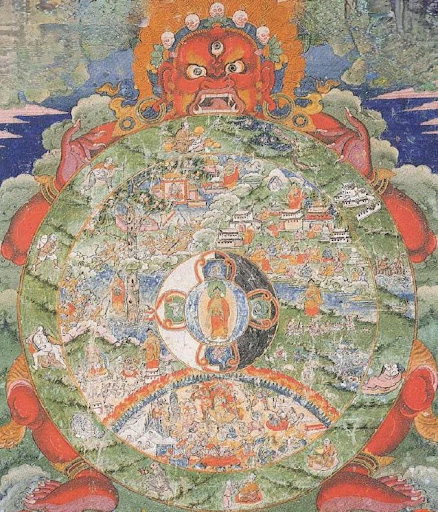
When the Buddha realized his profound awakening under the bodhi tree, he articulated his realization by teaching the twelve nidanas or links of dependent arising, pratityasamutpada. These teachings show step by step how confusion arises and how it dissolves. In traditional Buddhist sources, the twelve nidanas are commonly presented as spanning three lifetimes. The first two nidanas occur in the past, the next eight nidanas take place in the present, and the last two nidanas arise in the future.
The twelve nidanas are represented by:
PAST LIFE
1. Blind old grandmother ignorance
2. Potter making pot karmic formations
PRESENT LIFE
3. Monkey consciousness
4. Four men in a boat name & form
5. House with 6 windows six senses
6. Couple making love contact
7. Arrow in the eye feeling
8. Man drinking milk and honey craving
9. Monkey gathering fruit attachment
10. Pregnant woman becoming
FUTURE LIFE
11. Woman giving birth birth
12. Man carrying corpse aging, sickness, & death
In “The Wheel of Life: Illusion’s Game” found in Garuda II (Spring 1972), Trungpa Rinpoche presents the twelve nidanas in a timeless or on-the-spot way that is not tied to any particular time frame. Some have felt that this immediate way of presenting the twelve nidanas was only Trungpa’s attempt to placate Westerners who could not relate to or believe in the notion of past and future lives. They felt that Trungpa had to water down the classical presentation of the three lifetimes teaching to make it accessible for his young Western students.
As it turns out, the traditional texts do indeed present what they call the momentary or instant approach to the twelve nidanas. The great teacher Vasubandhu (4th to 5th century C.E.) talks about four ways to teach dependent origination in his commentary to the Abhidharmakosha, The Treasury of Abhidharma (chapter 3, verses 24-25):
- momentary or of one instant,
- prolonged or extending over several moments,
- succession through the connection of causes and effects, and
- static (meaning twelve different states of the five skandhas).
He notes that one Buddhist school, the Vaibhashikas, held that the Buddha taught dependent arising in a key sutra as static (twelve states of the five skandhas) as well as prolonged (over three successive lifetimes). Based on this famous text and others, the twelve nidanas are often taught in the context of three lifetimes. However, it is clear from Vasubandhu’s commentary that one can also see dependent arising in one moment or over a short period of time. Vasubandhu himself presented an example of the twelve nidanas found within one moment of committing a murder:
“In one and the same moment, when people who are prey to passion commit a murder, the twelve nidanas are actualized:
- their delusion is ignorance;
- their intention is the formations;
- their consciousness separate from a particular object is consciousness;
- the four skandhas coexisting with consciousness are name/form;
- the organs connected with name/form are the six sense faculties;
- the application of the six sense faculties is contact;
- experiencing the contact is feeling;
- desire [to kill] is craving;
- intensification of this desire due to the outbreak of residual kleshas is grasping;
- the physical action [such as stabbing with a knife] is becoming;
- the culmination of this action is birth [of a complete karmic result, i.e. their death];
- the maturing is old age; the end [of this action] is death.”
Buddhaghosa (5th century C.E.), a great Theravadin scholar, presented the twelve nidanas using similes that occur over a short period of time (Visuddhimagga,The Path of Purification, chapter 17, #303):
- ignorance: blind person
- formations: stumbling
- consciousness: falling
- name/form: appearance of a tumor
- six sense faculties: swelling of the tumor
- contact: something hits the tumor
- feeling: pain of the blow
- craving: longing for a remedy
- grasping: seizing a remedy that is unsuitable
- becoming: applying the ineffective remedy
- birth: tumor gets worse
- death: tumor bursts
Inspired by these traditional sources and Trungpa Rinpoche’s teaching, I came up with a party approach to the twelve nidanas for a talk I gave in the Ngedön School abhidharma course in Boulder in the early 1980s. The premise is that you are arriving at a party given in the house of someone you don’t know. You are welcome now to enter and enjoy the party!
1. ignorance
enter the door
you don’t know anyone, no reference point
freeze, go numb
heightened self-consciousness
2. formations
can’t stay at the door all night
you must do something
impulse to find a landing spot
vision narrows to find a reference point
head for the bar
3. consciousness
have now made it into the party
but need to nourish and fortify yourself
oral compulsion
have a drink
4. name/form
feel warmth pervading your body
feel fortified, empowered, embodied
feel more expansive
5. six sense fields
survey the situation
you look for someone to talk to
6. contact
see a certain someone who catches your eye
7. feeling
person looks good, attractive, worthy of your attention
you feel good, attractive, worthy of their attention
8. craving
so lonely
desire to talk to them, engage them
irresistible impulse
9. grasping
your mind is fixated on how to approach them
can’t ignore them
already caught
build up courage, come up with opening line, imagine scenarios, etc.
10. becoming
walk over to talk to the person
you start talking and keep talking and talking
11. birth
get to know the person
give birth to a relationship
high hopes you have found the right person
12. aging & death
conversation, focus starts to flag, diffuse
more gaps of silence
other person loses interest and walks away
big gap, no one to talk to, alone again
1. ignorance
panic, freeze, go numb
heightened self-consciousness, loneliness
2. formations
you head back to the bar for another drink, etc.
In this way, applying these teachings on the twelve links of dependent arising to everyday life situations brings them alive. This indeed was Trungpa Rinpoche’s genius. He did not talk down to his students nor did he water down the dharma. Rather he continually pointed to the timeless essence of dharma, which can be recognized in any place at any time.
 John Rockwell